Backsplash Tile Options: Subway, Glass, Mosaic and Stone
Backsplash tile comes in six main options: ceramic subway, porcelain, glass, mosaic, marble and stone, and handmade or brick tile. This guide compares how each looks, cleans and holds up behind a kitchen or bathroom counter.
- Licensed and insured
- Active PA HIC #PA192729
- Two decades of experience
- Serving Central Pennsylvania
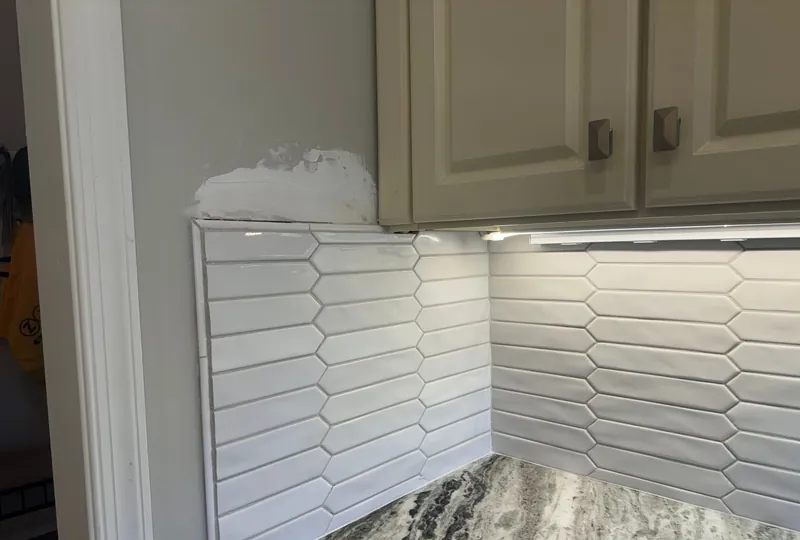
The photo shows white elongated hexagon backsplash tile that Tile Craft Artisans installed under grey cabinets.
What Is Backsplash Tile?
Backsplash tile is the tile on the wall behind a counter, sink or range, where it takes water, grease and heat. In most kitchens it fills the 18 inches between the counter and the upper cabinets.
That height comes from Bob Vila (2020). Behind the range, where there are no upper cabinets, the tile often runs higher, up to the hood.
The wall behind a stove takes the most punishment (Clever Mosaics, 2026). Grease, heat, moisture and stains all reach it. Oil splatter, sauce and smoke residue mark a painted wall there, while tile wipes clean. Running the tile all the way to the ceiling makes a narrow kitchen feel taller.
Is backsplash tile different from wall tile? Mostly in where it goes; the same thin wall tile works, but a backsplash sees more splashes and cleaning. So glazed, easy-clean tile suits it best.
Choosing the tile comes first, and our page on backsplash installation covers what happens next, from the wall prep to the grout. This guide sticks to the tile itself.
How Do the Backsplash Tile Materials Compare?
Ceramic and porcelain are the easiest backsplash tiles to live with, and glass is the brightest. Marble gives the most character but needs the most care.
Tile cost runs nationally from about $1 a square foot for ceramic to $35 for glass (RUBI, 2026). The table below compares the seven options on looks, heat, care and the price of the tile alone.
| Material | Look | Near the range | Cleaning and sealing | Tile cost per sq ft (RUBI 2026 where given) |
|---|---|---|---|---|
| Ceramic subway | Classic glazed rectangles in any color | Handles heat and wipes clean | Wipes clean; cement grout is sealed | $1 to $8 |
| Porcelain | Plain, stone-look or wood-look, in any size | Handles heat and wipes clean | Wipes clean; cement grout is sealed | $4 to $14 |
| Glass | Bright and reflective, clear or colored | Check the maker's specs behind a cooktop | Does not absorb water or grease | $12 to $35 |
| Marble and stone | Natural veining and texture, no two alike | Wipe up spills fast; acids etch marble | Sealed against stains; etches from acids | $7 to $25 |
| Mosaic | Small tile on sheets, in any material | Depends on the material | More grout lines to clean | By material |
| Zellige and handmade | Uneven, glossy and full of variation | Handles heat like other glazed ceramic | Wipes clean; wider joints to seal | Not given by RUBI |
| Thin brick | Rustic, warm and textured | Handles heat; sealed against grease | Sealed so grease does not soak in | Not given by RUBI |
The tile itself is often the smaller part of a backsplash budget, as the cost section below explains. The labor and the cuts often matter more.
Request a quote (717) 275-5648 Serving Central Pennsylvania
Which Subway Tile Sizes Suit a Backsplash?
Subway tile is a glazed rectangle, classically 3 by 6 inches, named for the tile in early New York subway stations. The 3 by 6 suits most backsplashes. Longer 3 by 12 or 4 by 12 tile means fewer grout lines and a more modern look.
The first of those stations opened on October 27, 1904 (Wikipedia, New York City Subway tiles). Heins & LaFarge did the earliest ceramic work there, starting in 1901. They worked with Grueby Faience of Boston and Rookwood Pottery of Cincinnati (Wikipedia). The tile was chosen because it stood up to heavy cleaning, which is still why it suits a backsplash.
Four sizes and shapes cover most subway backsplashes.
- 3 by 6 (classic). The original size suits almost any kitchen, from a farmhouse to a modern one.
- 3 by 12 and 4 by 12 (modern). Longer tile means fewer joints and a calmer, more modern wall.
- 2 by 8 and skinny sticks (vertical stacks). Narrow tile stacked upright draws the eye up toward the cabinets.
- Picket tile (a pointed-end shape). A subway tile with pointed ends that interlock, giving a pattern without a pattern layout.
Subway tile comes in glass, marble and handmade glazes, not just plain white ceramic. Herringbone, stacked and offset layouts are covered on our page of patterned tile layouts.
Is Glass Tile a Good Backsplash?
Yes; glass does not absorb water or grease and reflects light around the kitchen. It shows any flaw in the wall behind it, so it goes on a very flat wall with white thinset.
The thinset matters with glass (Custom Building Products, 2021). Glass tile takes a highly polymer-modified, bright white thinset, and some glass tile cannot go over a membrane. A flat wall here means within 1/8 inch in 10 feet (Custom Building Products, 2021).
Once it is up, glass wipes clean with a damp rag and resists heat (Clever Mosaics, 2026). That makes it one of the easiest backsplashes to keep looking new.
Three things decide how a glass backsplash turns out.
- Glass subway versus glass mosaic. Glass subway gives a clean, modern wall, while glass mosaic gives shimmer and more grout lines.
- Cut edges that need clean finishing. A cut glass edge is sharp and plain, so the open ends get a trim or a factory edge.
- Heat right behind a cooktop. Some glass tiles need extra grout space there for expansion, so check the maker's specs (Clever Mosaics, 2026).
Clear glass shows the thinset through it, which is why the white matters. A colored or back-painted glass hides the setting bed better.
What Are the Mosaic Backsplash Options?
Mosaic tile is small tile, commonly an inch or two across, sold on mesh-backed sheets. Hexagon, penny, square and marble mosaics give a backsplash texture, at the cost of more grout lines to clean.
Five mosaics come up most often on a backsplash.
- Marble mosaic. Small marble pieces, often in a basketweave or herringbone, give a stone backsplash without large slabs.
- Hexagon. Small hexagons give a honeycomb pattern that suits both vintage and modern kitchens.
- Penny. Tiny round tiles give a soft, retro texture with a lot of grout between them.
- Square. A grid of small squares reads clean and simple, especially in one color.
- Glass and stone blends. Mixed glass and stone pieces on one sheet give shimmer and texture together.
The same mosaics work on shower and bathroom floors, where the grout lines add grip. Mother-of-pearl mosaic is another shell option, covered in the questions below, though we do not install it.
Is Marble or Natural Stone a Good Backsplash?
Yes, if you seal it and wipe up acids; marble and limestone etch from lemon juice, vinegar and tomato. Harder stone such as slate or granite-look porcelain holds up better behind a busy range.
The Natural Stone Institute warns that products containing lemon, vinegar or other acids dull or etch calcareous stone. The same guide notes that stone sealers are impregnators, which repel stains rather than truly seal. So sealing guards a stone backsplash against stains, not against etching.
Cleaning products matter as much as the sealer. Scouring powders can scratch stone, and many rust removers contain hydrofluoric acid (Natural Stone Institute). That acid attacks every stone, granite and quartzite included.
Behind a stove, smooth stone suits better than textured or tumbled stone, because grease settles in the texture (Clever Mosaics, 2026). All natural stone is porous, so it is sealed regularly. Marble itself resists heat well.
Marble subway and marble mosaic are the most common stone backsplashes. Both look best where the cook wipes up citrus and tomato quickly.
Every stone we install, with its care and its sealing schedule, is on our page of natural stone tile.
Is Porcelain or Ceramic Better for a Backsplash?
Either works, because a backsplash takes no foot traffic. Glazed ceramic costs less and cuts more easily, and porcelain suits a wet wall behind a sink or a slab-look design.
Porcelain absorbs 0.5 percent water or less (ANSI A137.1), so it shrugs off a wet wall. A wall tile needs only PEI grade 1 or 2, because nobody walks on it (MSI, 2025). Both ceramic and porcelain are durable and heat-resistant behind a stove (Clever Mosaics, 2026).
Porcelain slabs give a near-seamless backsplash, with almost no grout lines at all. That makes them the most durable and the easiest to wipe down of the porcelain options.
On a backsplash, the choice comes down to the look you want and the tile you like. Either one is waterproof on its face once it is glazed and set.
The full difference between the two, from density to cost, is in our guide to the porcelain and ceramic tile difference.
Which Brick, Handmade and Colored Tiles Work as a Backsplash?
Thin brick, handmade zellige and painted Spanish-style ceramic all make distinctive backsplashes. Thin brick is sealed against grease, and handmade tile is set with tight, uneven joints that show its variation.
Four tiles give a backsplash more character than plain subway.
- Thin brick. Real brick cut thin gives a warm, rustic wall, and a sealer keeps grease from soaking in.
- Zellige. Handmade Moroccan-style tile with glossy, uneven faces catches the light differently on every piece.
- Painted Spanish-style tile. Hand-painted ceramic in patterns and colors turns the backsplash into the room's focal point.
- Green and colored glazes. A colored glaze on subway or square tile gives a bold backsplash that still wipes clean.
Each of these works best with the rest of the kitchen kept simple. Styles, colors and pairings in depth are on our page of kitchen backsplash ideas.
Which Backsplash Tile Is Easiest to Keep Clean?
The easiest backsplash to wipe down pairs large glazed tile or glass with thin, sealed grout lines. Where grease lands behind the range, the number of grout lines counts for more than the tile.
Three choices keep a backsplash easy to live with.
- Larger tile. Bigger pieces mean fewer joints for grease and food to settle into.
- A mid-tone grout that hides grease. A gray or taupe grout shows less staining than bright white.
- Sealing cement grout on schedule. A sealed cement grout soaks up far less grease and wipes clean for longer.
Glazed tile and glass wipe clean with warm water and a mild cleaner. The grout is the part that needs the attention. A stain-resistant grout suits a wall that gets splashed (Custom Building Products, 2021).
How Much Does Backsplash Tile Cost?
For ceramic, backsplash tile typically costs $1 to $8 a square foot nationally, and porcelain $4 to $14 (RUBI, 2026). A kitchen backsplash is a small area, so labor and cuts around outlets often cost more than the tile.
By the same national RUBI figures (2026), stone runs $7 to $25 and glass $12 to $35 a square foot. These are typical national ranges for the tile alone, not our prices.
A backsplash has more cuts per square foot than most tile jobs. Outlets, windows, the range hood and the ends of the cabinets all need cuts. That is where most of the labor goes.
Kitchen backsplash labor runs $10 to $20 per square foot nationally, or $80 to $120 an hour (TileHub, 2026). The rate reflects the precise cuts around cabinets, outlets and appliances.
With labor and tile together, a glazed ceramic backsplash comes to $7 to $30 a square foot nationally (TileHub, 2026). Glass, the dearest, comes to $20 to $100 installed, by the same national guide (TileHub, 2026). Porcelain sits at $9 to $40 and stone at $15 to $75 installed nationally (TileHub, 2026).
Most professional installers set a minimum charge of $200 to $400 nationally, whatever the size (TileHub, 2026). That minimum weighs on a small backsplash. Pairing it with another small tile job in the same visit lowers the cost per square foot.
Who Can Install Your Backsplash Tile in Central PA?
Tile Craft Artisans can install ceramic, porcelain, glass, mosaic, stone, zellige and thin brick backsplashes across Central Pennsylvania.
Behind every backsplash we install sit two decades of experience, an active PA HIC #PA192729, and full licensing and insurance. We install custom backsplashes for a new kitchen or when you replace a tired one during a remodel. The work runs from plain subway to luxury marble. When you hire, choose tile you have seen in person, since a photo hides the texture and the true color. We tile the wall, not the counter; the counter itself comes from its fabricator.
(717) 275-5648 · support@tcartisans.com · Serving Central Pennsylvania
What customers say
I chose tile craft artisans llc and was beyond impressed. The dedication to satisfaction and creativity surpassed my vision of my project. I 10/10 would recommend tile craft artisans llc to everyone looking to have any size project come to life.
Eddie did am amazing job! He came in (on moving day) and installed a beautiful kitchen backsplash for me. He was kind, respectful, and hardworking. He built trust immediately, and that was a big deal to me as a momma with two kiddos. His attention to detail in his work was clear, and he ensured the tiles in the corners lined up perfectly. I am not hard to please, but I was excited and grateful for the tedious work he endured to make my kitchen look amazing. Thanks, Eddie. 10/10, would recommend.
Tile Craft Artisans did an amazing job installing a tile floor in my foyer! The craftsmanship is impeccable, and the attention to detail is evident in every tile. The team was professional, punctual, and respectful of my home. They helped me choose the perfect design that complements my space beautifully. The whole process was smooth and stress-free. I couldn't be happier with the result and highly recommend Tile Craft Artisans for any tile work!
What Else Do Homeowners Ask About Backsplash Tile?
Homeowners ask which backsplash tile is easiest to install and whether a bathroom needs a backsplash. The third is whether mother-of-pearl tile is practical.
Which Backsplash Tile Is Easiest to Install?
Standard ceramic subway or mosaic sheets are the easiest, because they cut simply and hide small errors. Peel-and-stick panels are not tile and are not something we install. Our guide on how to install a kitchen backsplash walks through the steps.
Does a Bathroom Need a Backsplash?
Yes, behind a vanity sink, where water splashes the wall every day. A 4-inch strip works, and tile to the mirror or the ceiling makes it a feature.
Is Mother-of-Pearl Tile Practical for a Backsplash?
Yes, as an accent behind a sink, away from the range; the shell is naturally water-resistant. It is fragile, so it is set gently with unsanded grout, and harsh cleaners dull its shine. That care comes from Tiletopia (2026), and it is not a tile we install. It is cut with a wet saw and a diamond blade, and a light grout brings out its shimmer.
- Licensed and insured
- Active PA HIC #PA192729
- Two decades of experience
- Serving Central Pennsylvania