Kitchen Backsplash Installation in Central PA
Tile Craft Artisans handles kitchen backsplash installation across Central Pennsylvania. We install subway, mosaic, glass, marble and porcelain backsplashes, usually in 1 to 2 days.
Request a quote or call (717) 275-5648
- Licensed and insured
- Active PA HIC #PA192729
- Two decades of experience
- Serving Central Pennsylvania

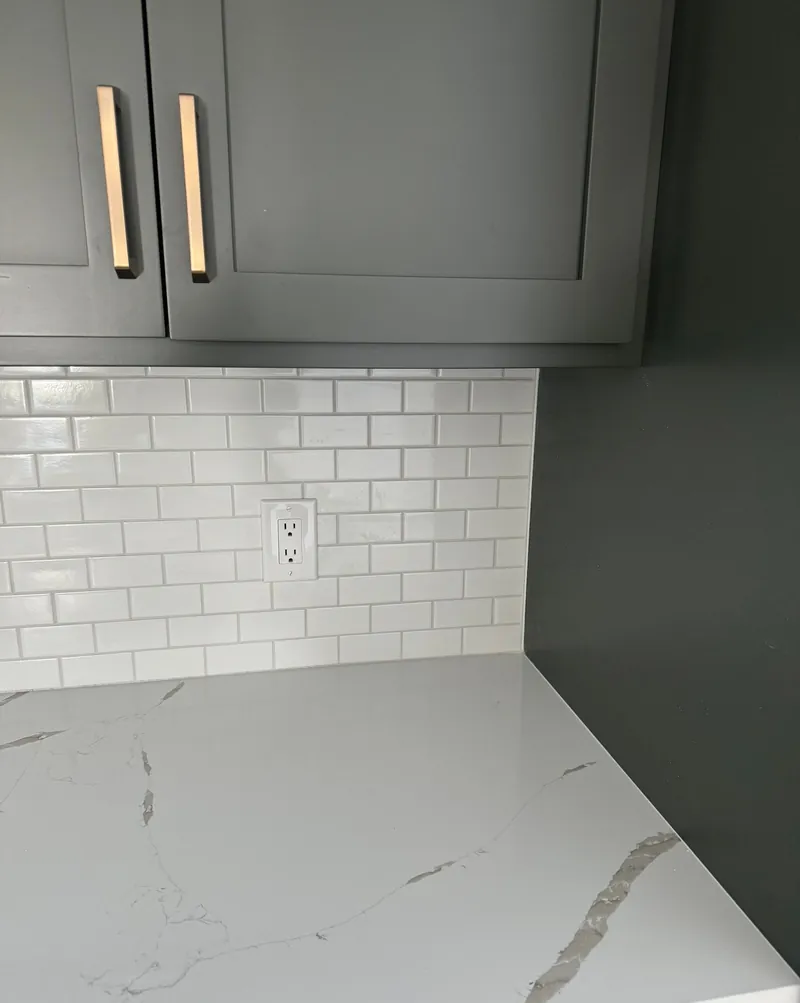
The photo shows a white diamond-pattern mosaic backsplash that Tile Craft Artisans installed under white kitchen cabinets.
What Does Backsplash Installation Involve?
A kitchen backsplash is the tiled wall between the countertop and the upper cabinets, protecting it from water and grease. Backsplash installation takes six steps.
- Measure and plan the layout. A precise layout is centered on the range, the sink or the wall's focal point. That way the cut pieces at each end match. The rows run from a level line rather than the counter, since few counters are perfectly level. About 10 percent extra tile is ordered for cuts (RUBI, 2026). A row is dry-laid on the counter first to show where the cuts fall. If an end would get a sliver, the layout shifts by half a tile.
- Protect the counters. The countertop is covered before any cutting or thinset starts.
- Prepare the wall. It is degreased, because thinset will not grip a greasy wall, then patched flat for tile. Drywall repair beyond patching is left to other trades.
- Set the tile, cutting around outlets and switches. The tile goes on in thinset, as the section on setting materials below explains. About 1/8 inch is left between the bottom row and the counter.
- Grout. Once the thinset sets, usually overnight, unsanded grout fills joints under 1/8 inch and sanded grout fills wider ones. Cement grout is sealed after 24 to 48 hours.
- Caulk the joint at the countertop. That joint takes caulk instead of grout, so it can move, and the inside corners do too.
Every step follows the same standards as the rest of our custom tile installation across Central Pennsylvania.
Do the outlets have to move? No, the tile is cut around them. If an outlet sits too deep once tiled, an electrician fits a box extender, which is not tile work.
Which Backsplash Tiles Do We Install?
Backsplash tile is wall tile behind a counter, so it needs to resist water, heat and cleaning, not foot traffic. We install eight kinds.
The table below compares the eight by look, upkeep and what their installation needs, so you can choose one for your kitchen.
| Tile | Look | Upkeep | Installation note |
|---|---|---|---|
| Ceramic subway | A glazed rectangle, classically 3 by 6 inches | Wipes clean; cement grout is sealed | Cuts easily |
| Porcelain | Solid colors and stone looks | Absorbs 0.5 percent water or less (ANSI A137.1), so no sealing | Suits a wet wall behind a sink |
| Glass | Reflects light around the kitchen | Absorbs no water or grease | Needs a very flat wall and white thinset; cut edges are finished cleanly |
| Marble | White and gray veining | Sealed, and it etches from lemon, vinegar and tomato | Marble subway and marble mosaic are the usual stone backsplashes |
| Mosaic | Hexagon, penny, square and marble on mesh-backed sheets | More grout lines to clean | Sheets about 12 by 12 inches |
| Zellige | Handmade glazed clay with uneven faces that catch the light | Glazed face wipes clean | Tight, uneven joints show its variation |
| Thin brick | Real brick faces, thin enough for a wall | Sealed against grease | Laid like tile, with brick-style joints |
| Porcelain slab | One panel with no grout lines | No sealing and no joints to clean | About 6 millimeters thick (ANSI A137.3) |
The 3 by 6 subway suits most backsplashes. Longer 3 by 12 or 4 by 12 tile leaves fewer grout lines and looks more modern. Mosaic tile is commonly an inch or two across. Either porcelain or ceramic works, because a backsplash takes no foot traffic. Glazed ceramic costs less and cuts more easily. Behind a busy range, harder stone such as slate, or granite-look porcelain, holds up better than marble or limestone. Each option is compared in more depth on our page of backsplash tile options, with its cost per square foot.
Does an Old Backsplash Have to Come Out?
Yes, in most kitchens; the old tile and adhesive come off so the new tile sits flat. The wall behind it is then patched flat for tile.
Rather than replace the old backsplash, you can tile over it when the old tile is flat, sound and well bonded. The new tile and thinset then usually add about 3/8 to 1/2 inch, so the outlet boxes need extenders from an electrician. On a bare wall, new tile can go straight onto sound, flat drywall that is clean and not glossy. A very uneven wall, or one that stays wet behind a sink, gets a backer board first.
Should Backsplash Tile Be Set With Thinset or Mastic?
You should set backsplash tile in thinset, which suits every tile, and use mastic only for smaller tile on interior walls. Thinset is a cement-based mortar. Mastic is a premixed organic adhesive.
A typical mastic, TEC Type 1 Mastic, meets ANSI A136.1 and is made for interior floors and walls. On walls, its maker rates it for tile up to 12 by 12 inches (TEC product data, 2026). Its listed tile types are ceramic, porcelain, natural stone, quarry and mosaic, and glass is not among them. Glass, large-format tile and heavy stone are set in thinset instead (ANSI A118.4 or A118.15). Thinset is spread only over as much wall as can be tiled within its open time, about 20 to 30 minutes. A mixed batch stays usable for about 2 to 4 hours at 70 degrees F (Schluter, 2026). For grout, epoxy resists stains and water best, so it suits the wall behind a range or sink. It is harder to work, though.
Which Backsplash Layouts Work Best?
Four backsplash layouts suit most kitchens: running bond, stacked, vertical and herringbone.
- Running bond. Subway tile is offset by half its length, the classic brick pattern.
- Stacked. Tile sits in a straight grid, joint on joint, for a clean modern wall.
- Vertical. A vertical stack draws the eye up and makes a short wall feel taller.
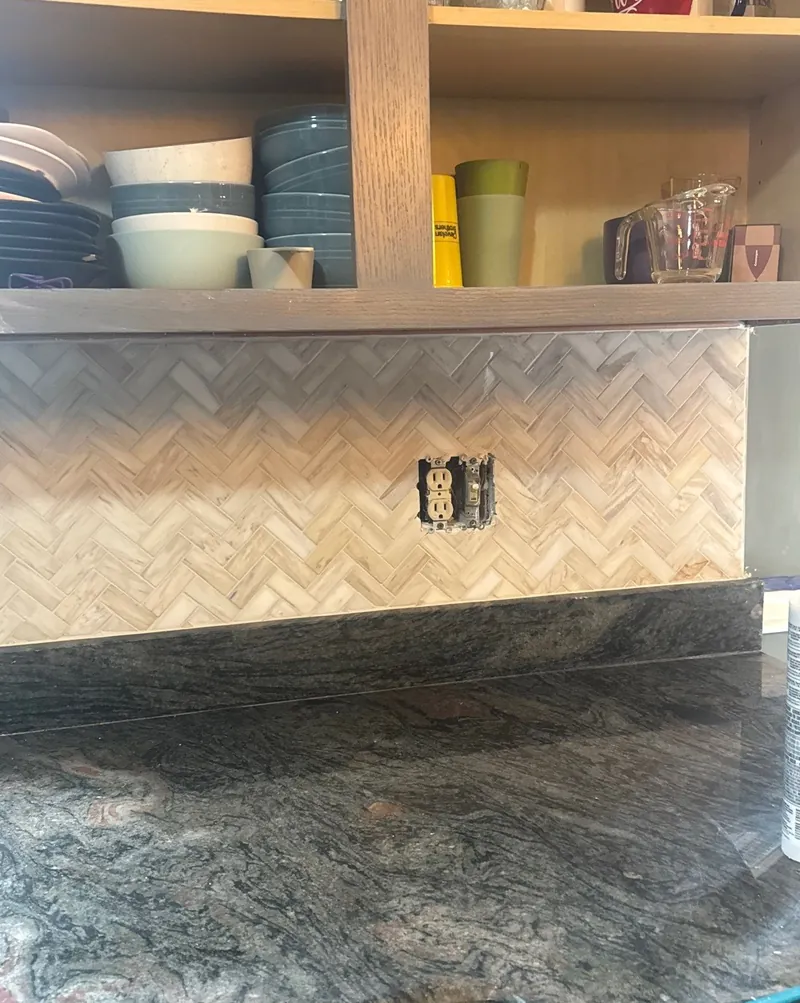
- Herringbone. Rectangles are set in a zigzag, and our page on herringbone and patterned tile shows the variations. Herringbone and chevron take 15 to 20 percent extra tile, according to RUBI (2026).
How High Should a Kitchen Backsplash Go?
A kitchen backsplash should fill the standard 18 inches between the countertop and the upper cabinets (Bob Vila, 2020). Behind a range hood, or where a wall has no upper cabinets, it can run full height.
Tiling to the ceiling or up to the range hood raises the price. Wrapped window returns and metal edge trim add to it too. Sideways, the tile ends where the upper cabinets end, or at a natural break such as a corner. An open wall end is finished with bullnose tile or a slim metal edge. The same 18 inches is used to size a backsplash in the cost section below.
How Long Does Backsplash Installation Take?
Most kitchen backsplashes take 1 to 2 days to install. The grout then cures before heavy cleaning. The kitchen stays usable during the work, apart from the counter under the wall being tiled. Small mosaics or many outlets add hours, not days. Done as a DIY project, a backsplash usually takes a weekend: one day to set the tile, another to grout and caulk.
What Does a Kitchen Backsplash Cost?
Nationally, an installed kitchen backsplash typically runs $480 to $1,700 (TileHub, 2026; HomeGuide, 2023). The price covers tile, setting materials and labor.
Installed, a backsplash runs $10 to $50 per square foot nationally, the wider range of TileHub (2026) and HomeGuide (2023). For a typical 25 square foot backsplash, TileHub (2026) gives $425 to $900 all-in, nationally. Labor alone runs $5 to $20 a square foot nationally (HomeGuide, 2023; TileHub, 2026). Nearly every row meets a cabinet, an outlet or a window, which is why labor costs so much per foot. To size your own, multiply the counter length in feet by 1.5, for the 18 inches up to the cabinets. A 12 foot run is then 18 square feet, so about 20 square feet of tile is ordered with the waste. Twenty feet of counter makes 30 square feet, which at HomeGuide's 2023 national range comes to about $300 to $1,500 installed. Ceramic tile runs $1 to $8 a square foot nationally (RUBI, 2026), so 30 square feet takes $30 to $240 of tile. Glass at $12 to $35 comes to $360 to $1,050 for the same wall, by the same national RUBI figures for 2026. Taking off an old tile backsplash typically adds $2 to $5 per square foot nationally (HomeGuide, 2023). We quote after a site visit.
Four factors decide where a backsplash falls in those ranges.
- Tile. Ceramic subway costs the least, and glass and stone cost the most.
- Square footage. Tiling full height, or up to the range hood, adds area.
- Layout. Herringbone, vertical and mosaic layouts slow the work.
- Outlets and cuts. Every outlet and switch means cuts, and moving a box forward is an electrician's job.
Ceramic subway in a standard layout, stopped at the cabinet line, costs the least. Stone or glass saved for the wall behind the range shows the most for the money. Booking the backsplash with other tile work in the house avoids a separate small-job minimum, which HomeGuide (2023) notes on small areas.
How Do You Keep a Kitchen Backsplash Clean?
Wipe a kitchen backsplash with a damp cloth and a pH-neutral cleaner, and clear grease behind the range early. Keep cement grout sealed, and reseal it as its maker directs.
Larger glazed tile, or glass with thin grout lines, is the easiest to keep clean. Behind the range, fewer grout lines matter more than the tile itself. A mid-tone grout hides grease better than bright white, and epoxy grout needs no sealing at all. For heavy soil, leave a tile and grout cleaner on for 3 to 5 minutes, then scrub and rinse. On marble and other natural stone, skip vinegar and other acidic cleaners, since acid leaves dull etch marks. Every surface is covered in our guide on how to clean tile and grout.
Who Installs Kitchen Backsplashes in Central PA?
Tile Craft Artisans installs kitchen backsplashes, from wall prep to grout, for homes across Central Pennsylvania. Behind every backsplash we set is a licensed and insured company, holding active PA HIC #PA192729 and two decades of experience. Kitchen customers and others rate us 5.0 out of 5 on Google and HomeAdvisor alike (September 2026). Backsplashes are installed all over Central Pennsylvania, including kitchens in Harrisburg, Lancaster, York and Hershey.
We do not install countertops, so the counter is in place before we start. Before you hire us, the site visit measures the wall and checks that it is flat enough for tile. Ask any installer to list removal, prep, tile work and trim separately, so backsplash quotes compare fairly. For a quote, call (717) 275-5648 on weekdays, 6 a.m. to 6 p.m., or email support@tcartisans.com.
(717) 275-5648 · support@tcartisans.com · Serving Central Pennsylvania
What customers say
I chose tile craft artisans llc and was beyond impressed. The dedication to satisfaction and creativity surpassed my vision of my project. I 10/10 would recommend tile craft artisans llc to everyone looking to have any size project come to life.
Eddie did am amazing job! He came in (on moving day) and installed a beautiful kitchen backsplash for me. He was kind, respectful, and hardworking. He built trust immediately, and that was a big deal to me as a momma with two kiddos. His attention to detail in his work was clear, and he ensured the tiles in the corners lined up perfectly. I am not hard to please, but I was excited and grateful for the tedious work he endured to make my kitchen look amazing. Thanks, Eddie. 10/10, would recommend.
Tile Craft Artisans did an amazing job installing a tile floor in my foyer! The craftsmanship is impeccable, and the attention to detail is evident in every tile. The team was professional, punctual, and respectful of my home. They helped me choose the perfect design that complements my space beautifully. The whole process was smooth and stress-free. I couldn't be happier with the result and highly recommend Tile Craft Artisans for any tile work!
What Else Should You Plan Around a Kitchen Backsplash?
You should plan the countertop, the job's scope, the look and the floor before the backsplash, because it goes in last. Decide too whether to do it yourself.
Do You Install Countertops?
No; the countertop goes in first from its supplier. We tile the backsplash after.
Can You Add a Backsplash Without Remodeling the Kitchen?
Yes; a backsplash can go into an existing kitchen without touching the cabinets or counters. The tile starts on the finished counter, and the joint between them is caulked.
Which Styles and Colors Suit a Kitchen Backsplash?
White, green, blue and marble backsplashes, and full-height tile behind the range, suit most kitchens.

The photo shows a Tile Craft Artisans backsplash in brick-look tile, in grey and red tones. More looks, by color and style, are on our page of kitchen backsplash ideas.
Can You Mix Tile Styles on a Backsplash?
Yes; you can mix tile styles, usually with a feature panel behind the range in a different tile or pattern. Keep one tile, color or grout line common to both so they read as one wall.
Should the Backsplash Match the Kitchen Floor Tile?
No; it should coordinate rather than match, sharing a color family or a scale with the floor, not the same tile. A contrasting floor keeps a busy backsplash from overwhelming the room. Floor choices for the same kitchen are on our page on kitchen floor tile.
Can You Install a Backsplash Yourself?
Yes; you can install a simple subway backsplash yourself. Glass, marble and patterns are harder to cut and finish cleanly. Plain ceramic subway and mosaic sheets are the easiest to start with, since they cut simply and hide small errors. The steps are set out in our guide on how to install a kitchen backsplash.
Request a quote or call (717) 275-5648
- Licensed and insured
- Active PA HIC #PA192729
- Two decades of experience
- Serving Central Pennsylvania