Bathroom Tile Installation in Central PA: Floors, Walls and Showers
Tile Craft Artisans tiles bathrooms across Central Pennsylvania. We tile floors, walls, showers and tub surrounds in porcelain, ceramic and stone. The removal, the prep and the tile over a heated floor are part of the job. We handle the tile side of a bathroom remodel, and we do not do the plumbing, vanities or countertops.
Request a quote or call (717) 275-5648
- Licensed and insured
- Active PA HIC #PA192729
- Two decades of experience
- Serving Central Pennsylvania
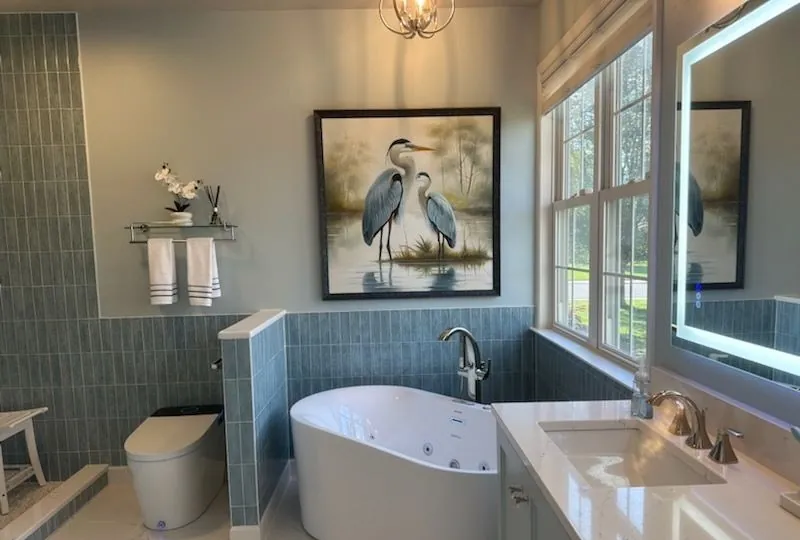
The photo shows a finished Tile Craft Artisans bathroom with blue-green wall tile, a freestanding tub and a white veined floor.
What Does Bathroom Tile Installation Involve?
Bathroom tile installation is tiling a bathroom's floor, walls and wet areas over a prepared surface, waterproofed wherever water hits. It takes five steps.
- Remove the old tile or flooring. The plumber pulls the toilet first. Old sheet vinyl or its glue from before about 1980 is lab-tested for asbestos before any scraping.
- Prepare the subfloor and walls. Both are made stiff and flat, as the floor preparation section below explains.
- Waterproof the shower and tub walls. Tile and grout on their own let water through, so a membrane goes behind the tile.
- Set the tile. A precise layout starts from two chalk lines through the middle of the room, so the cut tiles at each wall match. Tiles over 15 inches are back-buttered for full contact. The circle for the toilet flange is cut with a hole saw or wet saw, and the toilet hides its edge.
- Grout, caulk and seal. Once the thinset sets, usually overnight, sanded grout fills joints 1/8 inch and wider. Inside corners and the tub joint take caulk instead of grout, so they can move. Cement grout is sealed once it cures.
These steps are part of the custom tile installation we do across Central Pennsylvania. A bathroom floor usually takes 2 to 4 days from removal to cured grout. A whole tiled bathroom with a tile shower takes about 7 to 10 working days. You can walk on the floor lightly about a day after it is grouted.
Does the old floor always come out? Usually yes, so the subfloor can be checked. Sound, flat old tile can sometimes stay under new tile.
Which Parts of a Bathroom Can Be Tiled?
Five parts of a bathroom can be tiled: the floor, the walls, the shower, the tub surround and the baseboard.
- Floor. A bathroom floor takes porcelain in a matte or textured finish. Tile around 12 by 24 inches has fewer grout lines, so a small floor looks bigger. Small mosaics suit the floor as well, since they grip and fit around a toilet, but they leave more grout to clean.
- Walls. Walls can be tiled full height, half height or as wainscot. Fireclay Tile (2019) puts wainscot between 34 and 54 inches high, with 36 inches the average.
- Shower. A custom tile shower is built on a waterproofed pan, with the tile set over it. The pan falls about 1/4 inch per foot to the drain.
- Tub surround. The three walls around a tub are tiled over backer board and waterproofing. The joint where the tile meets the tub is caulked. A tub surround needs the backer, waterproofing and support that most often go wrong in DIY work.
- Baseboard. A tile base finishes the joint between the floor and the wall, and it takes a wet mop.
Which Tile Is Best for a Bathroom?
Bathroom tile has to take water, humidity and foot traffic. Porcelain is the best choice for floors and wet walls, and ceramic suits dry walls.
The table below compares six bathroom tiles, so you can choose one for each part of the room.
| Tile | Best area | Water and slip | Look |
|---|---|---|---|
| Porcelain | Floors and shower walls | Absorbs 0.5 percent water or less (ANSI A137.1); matte and textured finishes grip | Solid colors and stone looks |
| Ceramic | Dry walls and lightly used floors (floor-rated) | Absorbs more water than porcelain | Glazed colors and subway tile |
| Marble | Walls, and floors in a bathroom that will be sealed | Honed for floors; sealed, and it etches from acids | White and gray veining (Carrara, Calacatta) |
| Hexagon and penny mosaic | Floors and shower floors | Every grout line gives the foot an edge | Classic, and it suits older homes |
| Wood-look porcelain | Floors | A porcelain body; choose a matte finish with a wet DCOF of 0.42 or more | A wood plank look |
| Large-format porcelain | Floors and walls | Fewer grout lines; needs a flatter surface | 12 by 24 inches and up |
On a bathroom floor, a matte or textured tile rated at a wet DCOF of 0.42 or more resists slipping (ANSI A326.3). A mid-tone gray grout, or one a shade darker than the tile, hides wear on a floor. Bright white grout shows every mark underfoot, so it is better kept to walls. Epoxy grout resists stains and water best and needs no sealing, while cement grout is sealed as part of the install. Porcelain is the most durable of the common tiles. For a lightly used bathroom, floor-rated ceramic is enough. In a luxury bathroom, honed stone works, as long as it is sealed. When wet, honed or textured finishes grip better than polished ones. Each spot in the room is matched to its tile on our page on the best tile for showers and bathroom floors.
How Is a Bathroom Floor Prepared for Tile?
Floor preparation makes the subfloor stiff, flat and clean enough to hold tile. It means removing the old floor, checking the subfloor, and adding backer board or an uncoupling membrane.
The preparation runs in four steps.
- Remove the old floor. It comes up down to a sound subfloor.
- Check the subfloor's stiffness. The TCNA deflection limit is commonly L/360 for ceramic and porcelain, and L/720 for natural stone.
- Flatten it. The floor must be within 1/4 inch in 10 feet (TCNA Handbook). For tile with an edge of 15 inches or more, the limit is 1/8 inch in 10 feet.
- Add backer board or an uncoupling membrane. Cement backer board is screwed to a wood subfloor, and an uncoupling membrane lets the tile ride over small movement.
Most cracked bathroom floors come from three faults. The subfloor flexes, the tile is set tight against the walls, or the tile was never fully bedded. New tile and mortar usually add about 3/8 to 1/2 inch. If the floor ends up higher, the plumber may add a toilet flange extension. In Harrisburg and Lancaster city, over 40 percent of homes were built in 1939 or earlier (US Census Bureau, ACS 2024). Bathroom floors and plaster walls that old are checked for level and flex before any tile is chosen. Where sound old tile stays, its wide or deep grout lines are skimmed flat, so they do not print through. Tile choices, sizes and grout for the floor itself are on our page on bathroom floor tile.
Which Bathroom Tile Looks Are Popular Now?
Green, black, penny, hexagon and black-and-white tile are the most searched bathroom tile looks. By Ahrefs US monthly search volume (September 2026), "green tile bathroom" leads at 2,900, and black follows at 2,700. Penny comes next at 2,200, then hexagon at 2,000 and black and white at 1,900.
- Green. Texture, green and soft stone looks lead the Coverings 2026 tile trends. For bathrooms, jade green is one of the most useful of them.
- Black. Black tile works on a floor or a feature wall, under lighter walls.
- Penny. Penny and hexagon floors suit older Central PA homes, from rowhomes to farmhouses.
- Hexagon. Small hexagon mosaics grip well underfoot. Like penny and 2 by 2 porcelain mosaics, they need no sealing.
- Black and white. The classic version is a black-and-white hexagon or checkerboard floor under white walls.
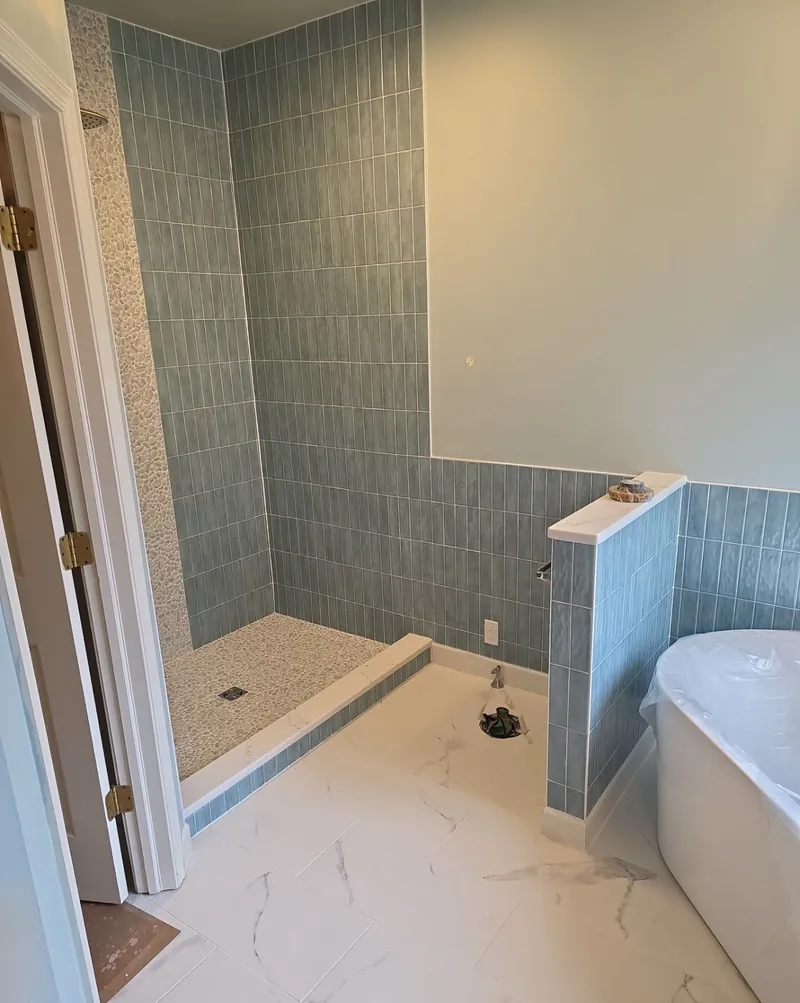


Whatever the look, big floor tile with thin joints reads as one surface, so the floor looks wider. More people search for pink bathroom tile, often a 1950s original, than for beige, gray or brown. An old pink or green bathroom from the 1950s can be kept and repaired, or its look recreated in new tile. More combinations for floors, walls and showers are on our page of bathroom tile ideas.
How Much Does Bathroom Tile Installation Cost?
Bathroom tile labor typically runs $5 to $22 per square foot nationally in 2026, with the tile on top (RUBI). Labor and porcelain for a 40 square foot floor come to about $360 to $1,440, by those national RUBI figures for 2026.
On that same floor, RUBI's 2026 national figures add about $120 to $280 to remove old ceramic. Prep adds about $80 to $200, by the same national RUBI figures for 2026. TileHub's 2026 national figures put bathroom wall tile labor at $7 to $14 per square foot. We quote after a site visit.
Four factors set where a bathroom falls in those ranges.
- Area. The floor, the walls and the shower are each priced by the square foot.
- Tile. Ceramic runs $1 to $8, porcelain $4 to $14 and natural stone $7 to $25 per square foot, nationally in 2026 (RUBI).
- Removal and prep. RUBI's 2026 national figures put removal at $3 to $7 and prep at $2 to $5 per square foot.
- The shower. By national TileHub (2026) and Inch Calculator (2023) figures, tiling a shower typically comes to $1,000 to $5,000.
Porcelain costs less to buy and set than natural stone.
Every range, room by room, is on our page on tile installation cost, labelled typical and national.
Who Installs Bathroom Tile in Central PA?
Tile Craft Artisans installs bathroom tile, from removal to grout, for homes across Central Pennsylvania. Tile Craft Artisans is licensed and insured, with active PA HIC #PA192729, and has two decades of bathroom tile work behind it. In any bathroom with a tile shower, the shower is waterproofed before its tile goes on. Reviewers on Google and HomeAdvisor rate us 5.0 out of 5 (September 2026). We tile bathrooms all over Central Pennsylvania, including homes in Harrisburg, Lancaster, York and Hershey.
We tile anything from a single bathroom floor to a whole bathroom with its shower. Before you hire us, a site visit measures the room, then checks its floor and walls for flatness, flex and moisture. The estimate you receive breaks the job into removal, prep, waterproofing, tile work and trim. Reach us at (717) 275-5648 from 6 a.m. to 6 p.m., Monday through Friday, or at support@tcartisans.com.
(717) 275-5648 · support@tcartisans.com · Serving Central Pennsylvania
What customers say
Absolutely amazing job!!!! My bathroom was a rather large project but these guys did fantastic. Would definitely recommend to anyone.
"I am beyond thrilled with the amazing bathroom tile work done by Tilecraftartisans. Despite the challenges i set Upon them, they went above and beyond to bring my dream bathroom to life. The craftsmanship, attention to detail, and dedication to making my vision a reality truly set them apart. I highly recommend their services for anyone looking to turn their dream space into a reality.
Excellent work and close attention to details. The customer service was outstanding, and my finished tiled bathroom and entryway exceeded my expectations.
What Does a Bathroom Remodel Include Besides Tile?
Beyond the tile, a full bathroom remodel needs plumbing, a vanity and fixtures, which other trades supply. The tile questions around them are the tub, the walls, safety, a heated floor, vinyl and repairs.
Can a Bathtub Be Turned Into a Tile Shower?
Yes; a bathtub can be turned into a tile shower, built in its place once the tub comes out. A plumber moves the valve and drain. In a tub space, a low tiled curb is the usual choice, because it keeps the pan above the bathroom floor. HomeGuide (July 2025) puts a typical tub-to-shower conversion at $3,500 to $15,000 nationally. The steps are set out on our page on tub-to-shower conversion.
Should Bathroom Walls Be Tiled Floor to Ceiling?
Yes, you should tile bathroom walls floor to ceiling in showers and small bathrooms. There it protects every wall from moisture and makes the room read larger. Half-height tile or wainscoting suits a powder room or a budget. Wall tile is laid out from a level line. It is centered on the wall or its focal point, so the cut pieces at each end match. Large tile needs a flatter wall and more support. Heights, layouts and tub surrounds are covered on our page on wall tile installation.
How Can Tile Make a Bathroom Safer?
Tile can make a bathroom safer with slip-resistant floor tile, a curbless shower entry and a contrasting border at level changes.
- Slip-resistant floor tile. Ask for a wet DCOF of 0.42 or more (ANSI A326.3). Small mosaics grip better still.
- Curbless shower entry. There is no step into the shower. A wide opening of about 36 inches leaves room for a walker or a helper.
- Contrasting border. A tile border in a contrasting color marks a step or a change in floor level.
Can a Tile Bathroom Floor Be Heated?
Yes; a tile bathroom floor can be heated with an electric mat laid under the tile during floor prep. We set the tile, and an electrician connects the mat. The electrician wires the circuit and the thermostat, with the ground-fault protection that the electrical code requires. Under the tile, the mat and its leveling layer raise the floor by roughly 1/4 to 1/2 inch. HomeGuide (September 2025) puts a heated tile floor at $15 to $40 per square foot nationally, tile included. Mats, sensors and thermostats are explained on our page on heated tile floors.
Is Vinyl a Waterproof Alternative to Bathroom Tile?
Yes on the surface; vinyl plank and sheet vinyl stop water and cost less. Tile lasts longer and is the only one of the two that belongs in a shower. In a small room, sheet vinyl keeps water out best, since one piece can cover the floor with no seams. This Old House (June 2026) puts installed waterproof vinyl plank at $6 to $20 per square foot nationally, with material and labor. Porcelain costs more, but it outlasts vinyl under heavy traffic and dropped pans. The options are compared on our page on waterproof flooring.
Can Cracked Bathroom Tile Be Repaired?
Yes; a single cracked tile can be cut out and replaced. Failed grout can be redone without retiling the floor. A small chip can be filled with a color-matched epoxy or porcelain repair filler, then polished flush. A replacement is matched from leftover boxes first, then found by the tile's name and shade lot. When shower tile works loose or cracks, water is often getting in behind it. A typical repair costs $232 to $474 nationally, by Homewyse's September 2026 figures. Repairs are covered in full on our page on tile repair.
Request a quote or call (717) 275-5648
- Licensed and insured
- Active PA HIC #PA192729
- Two decades of experience
- Serving Central Pennsylvania