Types of Tile: Porcelain, Ceramic, Stone and Glass Compared
Tile comes in five main families: porcelain, ceramic, natural stone, glass and cement. This guide compares where each works and how it wears, from a Central PA tile installer.
- Licensed and insured
- Active PA HIC #PA192729
- Two decades of experience
- Serving Central Pennsylvania
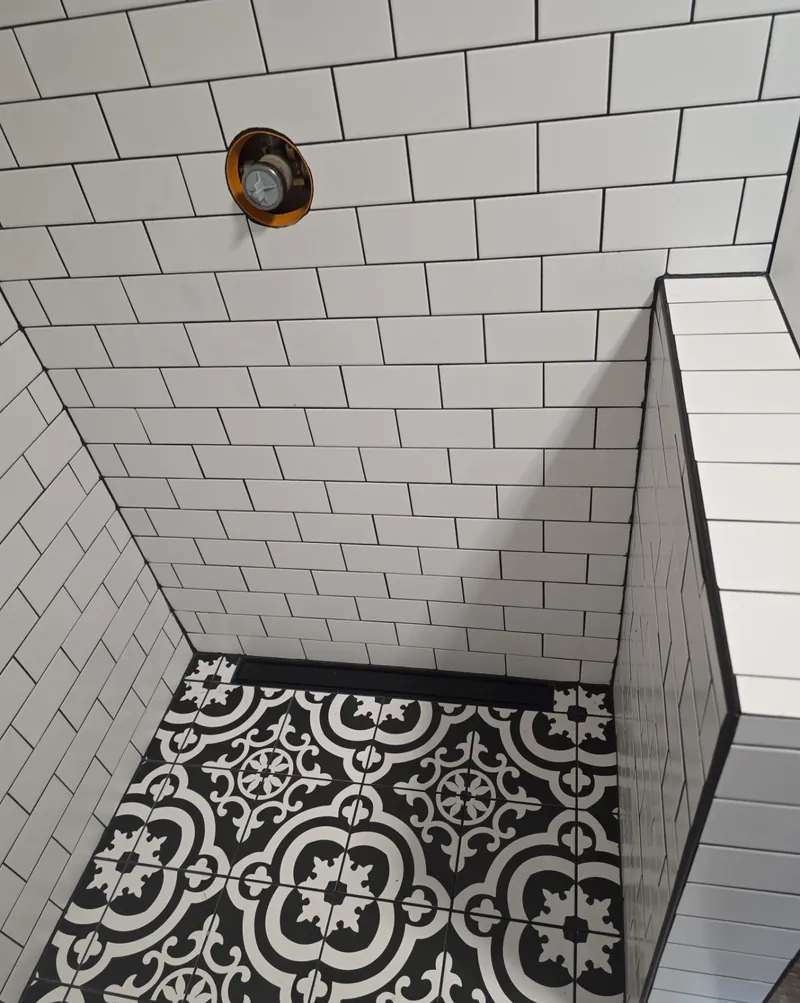
The photo shows two tile types in one Tile Craft Artisans shower: white subway walls and a black and white patterned floor.
What Are the Main Types of Tile?
Tile is a thin, hard slab of fired clay, stone, glass or cement used to cover floors and walls. The main types are porcelain, ceramic, natural stone, glass and cement tile.
Each of the five types of tile starts from a different raw material.
- Porcelain. Porcelain is fine, dense clay fired at a high heat until it absorbs almost no water. Full-body porcelain carries its color through, so minor chips show less (MSI, 2025).
- Ceramic. Ceramic is coarser clay fired at a lower heat, usually with a glazed face. Terracotta is one kind of ceramic (TileBar, 2026).
- Natural stone. Stone tile is quarried rock, such as marble, travertine, limestone and slate, cut into tile. It costs more than ceramic or porcelain, because it is quarried, cut and finished.
- Glass. Glass tile is colored glass, often in small mosaics. The color is coated on the underside and fired, and the tile resists water, mold and chemicals (TileBar, 2026).
- Cement. Cement tile is pigmented cement pressed into patterned tile and left to cure, not fired. That leaves it porous.
Mosaics come in every one of these materials (TileBar, 2026). Terrazzo is marble or glass chips set in cement or resin, and we do not install it.
Which type of tile is the most durable? Porcelain, because it is the densest and absorbs 0.5 percent water or less (ANSI A137.1).
Every one of these types is part of the tile installation we do across Central Pennsylvania, apart from cement tile.
Request a quote (717) 275-5648 Serving Central Pennsylvania
What Are the Pros and Cons of Each Type of Tile?
Porcelain and glazed ceramic are the easiest to live with. Natural stone and cement tile give the most character but need the most care.
Glass is waterproof and bright, but it shows every flaw in the wall behind it. The table below sets out the trade-offs, type by type.
| Type | Pros | Cons | Best for |
|---|---|---|---|
| Porcelain | Absorbs 0.5 percent water or less (ANSI A137.1) | Hard to cut and drill | Floors, showers and patios |
| Ceramic | Costs $1 to $8 a square foot nationally (RUBI, 2026) | Softer and more porous than porcelain | Walls, backsplashes and light-traffic floors |
| Marble | A veined look | Etches with acids; a copper coin scratches it (Kallisthos, 2020) | Bathroom walls and low-traffic floors |
| Travertine and limestone | A warm, soft-textured stone look | Soft, about 3 to 4 on the Mohs scale, and sealed | Bathrooms and living areas |
| Slate and granite | Slate's natural cleft grips; granite is far harder | Slate can flake along its layers | Entries, mudrooms and kitchen floors |
| Glass | Waterproof, bright and easy to wipe | Shows the wall behind it and chips on floors | Backsplashes and shower accents |
| Cement tile | Bold, pressed-in patterns | Porous and not freeze-thaw rated (Clé Tile) | Indoor feature floors and walls |
| Quarry tile | Unglazed and extruded; resists grease and chemicals (Metropolitan Ceramics, 2021) | A plain, utilitarian look | Commercial kitchens |
How Are Porcelain and Ceramic Tile Different?
Porcelain is ceramic made from finer clay and fired hotter, so it is denser and absorbs 0.5 percent water or less. Ordinary ceramic is softer and costs less, so it suits walls and light-traffic floors.
Porcelain is made to imitate stone, wood and cement (TileBar, 2026). Wood-look porcelain costs $5 to $15 a square foot nationally (RUBI, 2026). Ceramic wall tile needs only PEI grade 1 or 2, while floors need 3 or more (MSI, 2025).
- Porcelain.
The dense, durable choice for floors, showers and patios. See porcelain tile.
- Ceramic.
The lighter, cheaper choice for walls and backsplashes. See ceramic tile.
- Side by side.
How the two compare for water, wear, cutting and cost. See porcelain vs ceramic tile.
Which Natural Stone Tiles Are There?
Natural stone tile is quarried rock cut into tile. Marble, travertine, limestone and slate are the common ones, and granite, quartzite and basalt are the hardest.
The table below compares the seven stones by hardness and care.
| Stone | Hardness and wear | Sealing | Best for |
|---|---|---|---|
| Marble | About 3 on the Mohs scale; a copper coin scratches it (Kallisthos, 2020) | Sealed; etches with acids | Bathroom walls and floors |
| Travertine | About 3 on the Mohs scale, with natural holes that are filled | Sealed | Bathroom floors and living areas |
| Limestone | 3 or 4 on the Mohs scale (Kallisthos, 2020) | Sealed | Low-traffic rooms |
| Slate | Layered, with a natural cleft face | Sealed | Entries and mudrooms |
| Granite | Far harder than marble | Sealed regularly (Encore Stone Studio, 2024) | Kitchen floors and busy rooms |
| Quartzite | About 8 on the Mohs scale, the hardest common stone (Encore Stone Studio, 2024) | Sealed regularly | Kitchens and heavy-use floors |
| Basalt | Much harder than marble (Kallisthos, 2020) | Sealed | Modern floors and walls |
Carrara and Calacatta, the luxury marbles, both come from the Carrara region of Italy. Slate suits entries because it is hard and layered, and limestone suits low-traffic rooms because it is soft. Most stone is sealed, and marble etches from acids such as lemon juice.
Our page on natural stone tile covers the stones in more depth.
What Is Zellige Tile?
Zellige is handmade glazed clay tile from Morocco, with uneven faces and edges that catch the light. It is used most on backsplashes and shower walls, where its variation reads as texture.
Each tile differs in color and thickness, so it is set with tight, irregular joints and a layout sorted from several boxes. Glazed zellige is sealed after grouting in wet areas (Zia Tile zellige guide). Unglazed natural zellige is sealed before grouting, so the grout does not stain it. Clé Tile keeps a minimum joint of 1/16 inch and limits outdoor zellige to places that do not freeze. Outdoor floors take only its 2 by 6 bejmat. Glazed zellige works at pool waterlines only where it does not freeze, and zellige is not recommended for countertops.
Zellige is fired clay, a ceramic, and our page on kitchen backsplash installation shows where it is used most.
Are Cement Tiles a Good Choice?
Yes indoors, if you keep them sealed; cement tile is pigmented cement pressed into patterned tile, not fired, so it is porous. It suits bold patterned floors and walls, but not freezing outdoor spaces.
Cement tile is sealed before grouting, because dark grout can stain it for good (Cement Tile Shop, 2026). It is sealed again after grouting, then resealed on the maker's schedule. Porcelain printed with cement-tile patterns gives the look without the upkeep. Outdoors, cement tile goes only where it does not freeze, set above grade and sealed (Clé Tile).
What Are Terracotta and Quarry Tile?
Both are unglazed fired clay, the oldest kinds of tile. Terracotta is soft and porous and suits warm, rustic floors, while quarry tile is dense and made for commercial kitchens.
Terracotta is sealed, and quarry tile is extruded. The quarry tile to pick is vitreous, absorbing under 3 percent (Metropolitan Ceramics, 2021). The ANSI limit for quarry tile is 5 percent. Terracotta is for indoor floors here, not freezing patios. Our page on quarry tile installation covers kitchen floors.
How Are Tiles Rated for Wear, Water and Slip?
Three ratings on the box tell you where a tile belongs. They are the PEI rating for wear, the water absorption class and the DCOF for slip. A tile rated for walls only can fail on a floor even if it looks the same.
Each rating answers a different question about the tile.
- PEI. The PEI test measures how well a glazed tile resists abrasion (ASTM C1027). Grades 1 and 2 suit walls and light use, grade 3 most home floors, and 4 and 5 high traffic (MSI, 2025).
- Water absorption. ANSI A137.1 sorts tile into four classes, measured by ASTM C373. Impervious tile absorbs 0.5 percent or less, vitreous up to 3, semi-vitreous up to 7 and non-vitreous more than 7. Tile at 3 percent or less is generally considered frost-proof (CTASC, 2016), and only that tile goes outside here.
- DCOF. A level indoor floor that gets wet needs a wet DCOF of 0.42 or more (ANSI A326.3). The number is on the maker's data sheet, so check it before the tile is ordered. Under A326.3, makers class tile by use, from Interior Dry to Exterior Wet and Oils/Greases (TileLetter, 2022).
The PEI test mimics wear over time and says nothing about looks (MSI, 2025).
What Do Glazed, Matte, Textured and Rectified Mean?
Glazed tile has a fired glass coat on its face, and matte and textured glazes grip better than gloss. Rectified tile is ground to an exact size after firing, so it can be set with thinner grout joints.
Five finish words come up most often when you choose tile.
- Glazed and unglazed. A glaze is a glass coat fired onto the face, which gives color and seals it. Unglazed tile has the same color all the way through.
- Matte and textured. A matte or textured face grips better than gloss when wet, which makes it the choice for floors. The common finishes run from matte through semi-polished, or lappato, to polished and textured (MSI, 2025).
- Rectified. Rectified edges are ground precise and square. ANSI A108.02 sets the grout joint at three times the tile's size variation, and never under 1/16 inch (Ceramic Tile Foundation). So a tile varying by 1/16 inch needs a 3/16-inch joint, and rectified tile, which varies least, takes the thinnest.
- Fluted and 3D tile. These have a ridged or raised face. They are used on feature walls and shower walls.
- Groutless tile. No tile is truly groutless. Rectified tile and porcelain slabs only make the joints thinner and fewer.
Large porcelain panels take this furthest, and our page on porcelain slabs explains them.
Which Type of Tile Is Best for Bathrooms and Floors?
Porcelain is the best all-round tile for bathroom floors and busy floors, because it is dense, waterproof and hard-wearing. Natural stone, ceramic and zellige work too, where they suit the wear and the care they need.
The table below matches each space to the types that suit it.
| Space | Best types | Avoid |
|---|---|---|
| Shower floor | Small porcelain or stone mosaics | Large glossy tile |
| Bathroom walls | Ceramic, porcelain, zellige or marble | Unsealed cement tile |
| Kitchen floor | Porcelain or granite | Soft marble in high traffic |
| Entry and mudroom | Porcelain or slate | Polished tile |
| Outdoor patio | Frost-rated porcelain | Ceramic, cement tile and terracotta |
Small mosaics of 2 by 2 or 3 by 3 inches suit shower pans (MSI, 2025). Their many joints help drainage and grip. Glass belongs on floors only as small mosaics (TileBar, 2026). Large-format tile, commonly 24 by 24, 24 by 48 or 48 by 48 inches, cuts the grout lines (MSI, 2025). Any tile with an edge of 15 inches or more needs a flatter floor.
For a wet room in particular, our guide to the best tile for showers and bathroom floors goes further.
What Do the Different Types of Tile Cost?
Ceramic tile costs the least, typically $1 to $8 a square foot, and porcelain $4 to $14, nationally (RUBI, 2026). Glass is the dearest, with stone between.
Stone runs $7 to $25 and glass $12 to $35 a square foot, by the same national guide (RUBI, 2026). Labor is priced separately, and none of these is our price. Natural stone costs 40 to 100 percent more to install than ceramic or porcelain (TileHub, 2026). Our page of tile prices per square foot adds the labor and the prep.
Who Installs Porcelain, Ceramic and Stone Tile in Central PA?
Tile Craft Artisans installs porcelain, ceramic, zellige, natural stone, glass and stone mosaic, porcelain slabs and quarry tile across Central Pennsylvania. When you hire, bring the tile's PEI grade, absorption class and DCOF, so the choice fits the room. We are a licensed and insured company with active PA HIC #PA192729 and two decades of experience in custom tile.
(717) 275-5648 · support@tcartisans.com · Serving Central Pennsylvania
What customers say
Absolutely amazing job!!!! My bathroom was a rather large project but these guys did fantastic. Would definitely recommend to anyone.
Eddie did an absolutely incredible job on our shower—we are beyond happy with how it turned out. The final result is not only beautiful but truly exceeded our expectations in every way. His attention to detail, craftsmanship, and pride in his work really show.
On top of his talent, Eddie is one of the kindest and most professional people we’ve had work in our home. He was always friendly, respectful, and made the entire process feel easy and stress-free. We felt completely comfortable having him in our space, which means so much.
If you’re considering a shower remodel, I genuinely cannot recommend Eddie enough. He is skilled, trustworthy, and truly passionate about what he does—you will be in the best hands!
Eddie did am amazing job! He came in (on moving day) and installed a beautiful kitchen backsplash for me. He was kind, respectful, and hardworking. He built trust immediately, and that was a big deal to me as a momma with two kiddos. His attention to detail in his work was clear, and he ensured the tiles in the corners lined up perfectly. I am not hard to please, but I was excited and grateful for the tedious work he endured to make my kitchen look amazing. Thanks, Eddie. 10/10, would recommend.
What Else Do Homeowners Ask About Tile Types?
Homeowners ask whether thicker tile is better and which tiles need sealing. The third is whether different tile types can be mixed in one room.
Is Thicker Tile Better?
No; thickness says little about strength, because density and the rating matter more. Most porcelain floor tile is about 8 to 10 mm thick, and outdoor pavers about 20 mm. Rocagres (2026) puts outdoor pavers at 20 to 30 mm, and Daltile's 2 cm paver is 3/4 inch.
Which Tiles Need Sealing?
Natural stone, cement tile, terracotta and unglazed quarry tile need sealing, and so does cement-based grout. Glazed ceramic, porcelain and glass do not.
Can Different Tile Types Be Mixed in One Room?
Yes; different tile types can be mixed in one room, and a porcelain floor with a zellige or marble wall is common. Where two tiles meet on a floor, their thicknesses are matched or a trim piece covers the change.
- Licensed and insured
- Active PA HIC #PA192729
- Two decades of experience
- Serving Central Pennsylvania