Concrete Contractor in Central PA: Driveways, Patios, Foundations
We pour concrete driveways, patios, sidewalks and slabs, and build and repair house foundations across Central Pennsylvania. Tile is our main trade, and we can pour the slab that outdoor tile goes on.
Request a quote or call (717) 275-5648
- Licensed and insured
- Active PA HIC #PA192729
- Two decades of experience
- Serving Central Pennsylvania
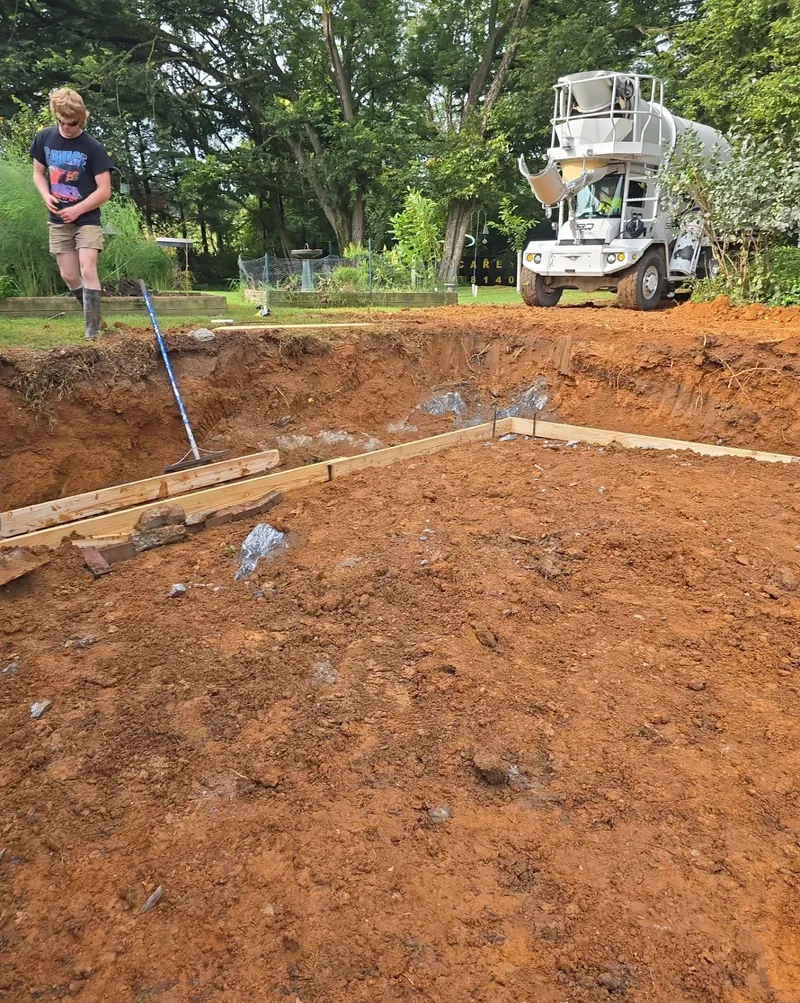
The photo shows a concrete truck arriving at a Tile Craft Artisans foundation site, with the forms set out.
What Does a Concrete Contractor Do?
A concrete contractor forms, pours and finishes concrete for driveways, patios, walks, slabs and foundations. What decides how long it lasts happens below it: the digging, the stone base and the steel.
Six steps take a slab from bare ground to finished concrete.
- Dig out and grade. The subgrade is shaped to drain and compacted before anything else goes down (Ohio Concrete, 2014).
- Compact a stone base. A compacted, trimmable fill such as crusher-run goes under the slab (NRMCA CIP 1).
- Set the forms and the steel. Standard 2 x 4 forms give the 3 1/2-inch minimum thickness for walks, drives and patios (Ohio Concrete, 2014).
- Pour and finish. Concrete goes in at a 3 to 5-inch slump with no water added (NRMCA CIP 2). It is finished only after the bleed water is gone.
- Cut the control joints. Each groove is at least a quarter of the slab's depth, and never under 1 inch (NRMCA CIP 6).
- Cure it. Curing runs at least 3 to 7 days, so the concrete keeps the water it needs to gain strength (NRMCA CIP 11). Plastic sheeting of at least 4 mils, or a curing compound to ASTM C309 or C1315, holds the water in.
Concrete is weak in tension, so it cracks as it shrinks, and joints decide where (NRMCA CIP 6). Isolation joints separate a slab from walls, footings and steps, and a driveway from the walk. Isolation joints are filled with a premolded strip, such as fiber board or compressible foam. Construction joints fall where two pours meet, usually at the end of a day. Wire mesh does not stop cracking; it only keeps cracks from opening. Conventional saw cuts go in 4 to 12 hours after finishing, and early-entry saws run 1 to 4 hours after it. On hot or windy days, above about 5 mph, the surface can dry fast (NRMCA CIP 5). It then shows shallow plastic shrinkage cracks 1 to 3 feet apart, so it is kept moist for at least 3 days.
Do you pour small jobs such as a shed pad? Yes; pads and small slabs are part of our concrete work.
Concrete sits beside our main work, the custom tile we install across Central Pennsylvania, and it often goes under it.
What Concrete Work Do You Do?
We pour driveways, patios, sidewalks, slabs and pads, build house foundations, and repair foundations and cracked concrete. For businesses, we pour floors and slabs.
- Driveways.
A driveway is poured air-entrained and jointed so it stands up to salt and frost. It thickens to 6 inches where it crosses a public sidewalk (Ohio Concrete, 2014). See concrete driveway installation.
- Patios and slabs.
Patios, pads and slabs are poured with the slope and joints they need. A patio falls about 1/4 inch per foot away from the house (BELK Tile, 2026). See concrete patios and slabs.
- Sidewalks and walkways.
Walks are poured and jointed into near-square panels, none longer than 1.5 times its width (NRMCA CIP 6). See concrete sidewalks and walkways.
- House foundations.
Footings go below the township's frost depth before the walls go up. See house foundations.
- Foundation repair.
Cracked and failing foundations are repaired once the cause is found. See foundation repair.
- Concrete repair.
Cracked, scaled and sunken concrete is repaired or replaced in sections. See concrete repair.
- Commercial concrete.
Floors and slabs for businesses are poured to the load they carry. Metal dowels carry heavy loads across the joints (NRMCA CIP 6). See commercial concrete contractors.
- Cost guide.
Typical national prices per square foot for driveways, patios and walks. See concrete driveway, patio and sidewalk cost.
What Makes Concrete Last Through Central PA Winters?
Concrete lasts here when it is air-entrained, laid on compacted stone and cut with control joints. Freeze-thaw cycles and road salt break down concrete that skips these steps.
Five choices decide how an outdoor slab does through a Central PA winter.
- Air entrainment. Water grows about 9 percent as it freezes (Ohio Concrete, 2014). Millions of tiny air bubbles in the concrete give that ice room, so it does not crack the surface (NRMCA CIP 2). Exterior flatwork is ordered at 6 percent air, plus or minus 2 (Ohio Concrete, 2014). Most scaling comes from concrete with too little entrained air (NRMCA CIP 2).
- Strength. Exterior slabs that will see de-icing salt are ordered at 4,000 psi (NRMCA CIP 2). Ohio Concrete's recommendation asks for 4,500 psi, with a water-cement ratio of 0.45 or less (2014). A stronger, less watery mix lets less water into the surface.
- Thickness and base. Walks, driveways and patios are at least 3 1/2 inches thick on a compacted base. Most codes ask for 6 inches where a driveway crosses the public sidewalk (Ohio Concrete, 2014).
- Control joints. A precise joint layout is planned before the pour. Joints go 24 to 36 times the slab thickness apart, never more than 15 feet (NRMCA CIP 6). For a 4-inch slab that is about 10 feet. Panels stay nearly square, no longer than 1.5 times their width. Concrete then cracks in the joints, not across the slab.
- Curing and the first winter. Curing runs at least seven days (Ohio Concrete, 2014). Concrete left to dry out early can lose up to half its potential strength (NRMCA CIP 11). No de-icer goes on it the first winter (NRMCA CIP 2). Ammonium and magnesium-based salts are never used on concrete, because they attack the surface.
Finishing and drainage matter as much as the mix. Working bleed water back into the surface, or steel-troweling outdoor concrete, weakens the top layer and leads to scaling (NRMCA CIP 2). Magnesium-based salts spread on roads before snow are tracked in by cars and build up on driveways. Gutters, downspouts and ground sloped away from the slab keep water off it (Ohio Concrete, 2014). After the first winter, rock salt and calcium chloride are acceptable on properly made concrete in moderate amounts (NRMCA CIP 2).
A slab poured to these figures is the durable base a Central PA driveway or patio needs.
Can You Pour a Slab and Tile It Too?
Yes; we can pour a patio or porch slab and tile it, so one company answers for both layers. The slab is poured with the slope and joints the tile needs, then cured before any tile goes on.
A slab is cured at least 28 days before tile is bonded to it (Custom Building Products, 2023). A patio slab falls about 1/4 inch per foot away from the house (BELK Tile, 2026). A slab meant for tile gets a coarse finish so thinset grips (Custom Building Products, 2023). It has to take water in, with no sealer or curing compound left on it. Hairline slab cracks get a crack-isolation membrane to ANSI A118.12 before any tile goes on. An uncoupling membrane takes the slab's small seasonal movement instead of the tile. The slab's control joints carry up through the tile as movement joints (TCNA EJ171). Outdoor tile needs those joints every 8 to 12 feet (CTASC, 2022). A 4-inch slab jointed about every 10 feet already gives them (NRMCA CIP 6). Our page on outdoor and patio tile installation covers the tile layer.
Do You Repair Concrete Steps?
Yes; we repair cracked and crumbling concrete steps. We can tile concrete steps for a new, slip-resistant surface.
Pennsylvania's building code caps risers at 8 1/4 inches (34 Pa. Code section 403.21). It asks for treads of at least 9 inches, measured nosing to nosing. A repair keeps every step within those sizes. A repaired step can take tile once it is sound again, and our page on tile steps explains the treads and nosings.
Do You Build Retaining Walls and Stonework Too?
Yes; we build block, stone and concrete retaining walls and flagstone patios and walks. Brick and chimney work sits with them in our masonry work.
Under the International Residential Code, an unsupported wall holding back more than 48 inches of soil is engineered (section R404.4). So is any wall over 24 inches that also carries other loads. Its design gives a safety factor of 1.5 against sliding and overturning. Our page on the masonry contractor side of the business covers the wall types.
What Does Concrete Work Cost in Central PA?
A poured driveway typically runs $9.86 to $12.11 a square foot and a patio $10.59 to $12.99 nationally (Homewyse, September 2026). Concrete flatwork is priced by the square foot, and digging, the base and tearing out old concrete move the price.
A sidewalk runs $12.33 to $15.10 a square foot nationally (Homewyse, September 2026). HomeGuide puts a plain gray driveway at $6 to $10 a square foot nationally (2025). A two-car driveway runs $2,400 to $8,600 nationally (HomeGuide, 2025). Taking out old concrete, with disposal, runs $3 to $8 a square foot nationally (HomeGuide, 2025). A 10 by 10-foot slab costs $300 to $800 to remove, nationally (HomeGuide, 2025). All of these are typical national figures, not our prices. We quote after seeing the site.
Five things set the price of a concrete job.
- Square footage. Flatwork is priced per square foot, so the area is the base of the quote.
- Thickness. A thicker slab takes more concrete, such as the 6 inches where a driveway crosses a public sidewalk.
- Tearing out old concrete. Breaking up and hauling away an old slab adds work before the new pour.
- Site access. A truck that cannot reach the pour means pumping or wheeling the concrete in.
- The finish. Choose a broom finish for outdoor flatwork, because it gives grip in rain and frost.
Who Pours Concrete in Central PA?
Tile Craft Artisans pours and repairs concrete for homes and businesses across Central Pennsylvania, alongside our tile work. When you hire for concrete, ask for the air content, the strength and the joint layout in writing. Ohio Concrete's recommendation asks for the finisher to hold ACI's Concrete Flatwork Finisher certification (2014), a fair question for any contractor. Footings go below the local frost depth, which each township sets (Light-Heigel & Associates permit packages). That is 36 inches in Middle Paxton and 40 in Halifax, both in Dauphin County. Pennsylvania's Home Improvement Consumer Protection Act asks for a signed, written contract on any home job over $500 (PA Senate leaflet, 2019). The contract gives the start and end dates, the cost and a three-day right to cancel. Registered contractors carry at least $50,000 of liability cover for injury and $50,000 for property damage (FLB Law, 2022). The same leaflet advises getting at least three written estimates. Pay no more than a reasonable down payment, typically one-third, and hold the final payment until the work is complete. The contractor secures any permits the job needs. The company is licensed and insured, holds active PA HIC #PA192729, and brings two decades of experience.
(717) 275-5648 · support@tcartisans.com · Serving Central Pennsylvania
What customers say
Absolutely amazing job!!!! My bathroom was a rather large project but these guys did fantastic. Would definitely recommend to anyone.
Eddie did an absolutely incredible job on our shower—we are beyond happy with how it turned out. The final result is not only beautiful but truly exceeded our expectations in every way. His attention to detail, craftsmanship, and pride in his work really show.
On top of his talent, Eddie is one of the kindest and most professional people we’ve had work in our home. He was always friendly, respectful, and made the entire process feel easy and stress-free. We felt completely comfortable having him in our space, which means so much.
If you’re considering a shower remodel, I genuinely cannot recommend Eddie enough. He is skilled, trustworthy, and truly passionate about what he does—you will be in the best hands!
Eddie did am amazing job! He came in (on moving day) and installed a beautiful kitchen backsplash for me. He was kind, respectful, and hardworking. He built trust immediately, and that was a big deal to me as a momma with two kiddos. His attention to detail in his work was clear, and he ensured the tiles in the corners lined up perfectly. I am not hard to please, but I was excited and grateful for the tedious work he endured to make my kitchen look amazing. Thanks, Eddie. 10/10, would recommend.
What Else Do Homeowners Ask About Concrete?
Homeowners ask when in a Central PA year concrete is poured and how soon a new driveway takes a car. The third is whether new concrete should be sealed.
Can Concrete Be Poured in Cold Weather?
Yes, concrete can be poured in cold weather if it is kept from freezing while it gains strength. ACI 306 treats air below 40 degrees F as cold weather, so most flatwork here is poured from spring to late fall. Fresh concrete freezes below about 25 degrees F (NRMCA CIP 27). It is protected until it reaches 500 psi, about two days after the pour. Concrete that freezes early can lose more than half its potential strength. A 20-degree drop in concrete temperature roughly doubles its setting time. New concrete is kept from freeze-thaw cycles until it reaches 3,500 psi. In cold weather it is kept above 50 degrees F (NRMCA CIP 11). For the first 24 hours it is not let cool faster than 5 degrees an hour.
How Soon Can You Drive on a New Driveway?
You can usually walk on new concrete after a day or two and drive a car on it after about a week. Heavy trucks wait until it has cured for about 28 days. Concrete Network (2026) gives 24 to 48 hours to walk and 7 to 10 days for cars. Keep cars off the edges for the first weeks, where new concrete is weakest.
Should New Concrete Be Sealed?
Yes, new concrete should be sealed on driveways and patios that see road salt. A breathable silane or siloxane sealer slows water and salt getting in. Clean the concrete first, and reseal as the sealer maker directs. The sealer goes on no sooner than 30 days after the pour and before the first freeze (Ohio Concrete, 2014). New concrete needs 30 days of air-drying before it meets de-icing salt. The concrete should be reasonably dry when the sealer goes on (NRMCA CIP 2). A stiff brush and a mild cleaner clean a patio.
Request a quote or call (717) 275-5648
- Licensed and insured
- Active PA HIC #PA192729
- Two decades of experience
- Serving Central Pennsylvania