Bathroom Floor Tile: Choosing and Installing the Right Tile
The right bathroom floor tile grips when wet, suits the room and sits on a floor stiff enough to stop cracks. We install porcelain, ceramic, mosaic and stone bathroom floors across Central Pennsylvania.
Request a quote or call (717) 275-5648
- Licensed and insured
- Active PA HIC #PA192729
- Two decades of experience
- Serving Central Pennsylvania
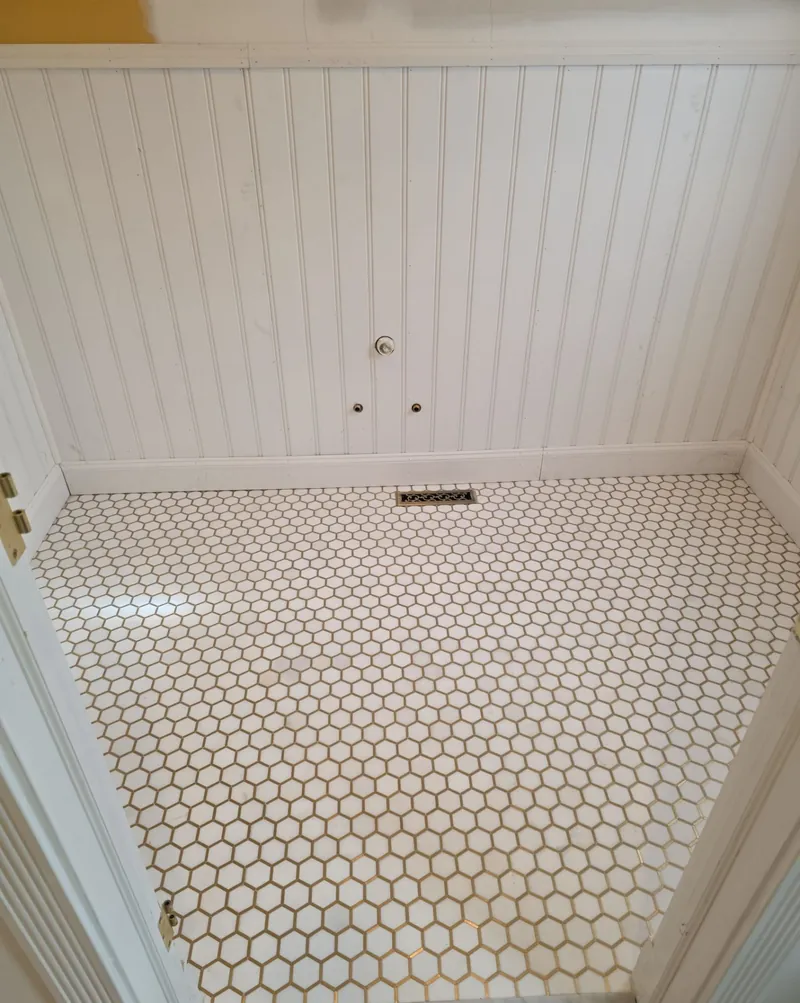
The photo shows a white hexagon mosaic bathroom floor that Tile Craft Artisans laid under beadboard walls.
What Makes a Good Bathroom Floor Tile?
A good bathroom floor tile absorbs almost no water, grips when wet, and is rated for floor traffic. Porcelain meets all three, which is why it is the usual choice.
Three things on the box or the data sheet tell you whether a tile belongs on a bathroom floor.
- Water absorption. Porcelain soaks up 0.5 percent of its weight in water or less, the line ANSI A137.1 draws for it.
- Grip. A wet DCOF of 0.42 or more, measured under ANSI A326.3, marks a tile as slip-resistant for a level floor.
- A floor rating on the box. Some thin wall tile is not rated for floors at all, so the box has to say floor.
Is ceramic tile fine on a bathroom floor? Yes; glazed ceramic rated for floors works in a bathroom that is not a wet room. Porcelain is the safer choice where water pools.
A bathroom floor is one part of the room. Our page on bathroom floors and showers covers the whole remodel, walls and tub surround included.
Is Porcelain the Best Bathroom Floor Tile?
Yes, for most bathrooms; porcelain is dense, waterproof through the body, and comes in matte and textured finishes that grip. Natural stone is the alternative for a luxury floor, but it needs sealing, and marble and limestone etch.
The table below compares the four common choices for a bathroom floor.
| Tile | Why choose it | Watch for |
|---|---|---|
| Matte porcelain | Dense, low-absorption and easy to clean, in solid colors, stone looks and wood looks | A matte face still needs its DCOF checked on the data sheet |
| Textured porcelain | The most grip of the large tiles, for a floor that gets wet often | Texture holds more dirt, so it needs a scrub brush now and then |
| Glazed ceramic | Costs less and cuts more easily, fine in a powder room | Must be rated for floors; absorbs more water than porcelain |
| Natural stone | Marble, slate or travertine for a luxury look | Needs sealing on a schedule, and acids etch marble and limestone |
Porcelain hides a chip better when its color runs through the body. A glazed tile shows its clay body where the glaze chips.
The full comparison, with the shower floor included, is in our guide to the best tile for showers and bathroom floors.
Which Bathroom Floor Tile Resists Slipping?
Tile with a wet DCOF of 0.42 or more, in a matte or textured finish, resists slipping on a bathroom floor. Small mosaics grip better still, because every grout line gives the foot an edge.
Three steps make a bathroom floor safer underfoot.
- Read the DCOF on the data sheet. The number is printed by the tile maker, and 0.42 wet is the one to look for on a level floor.
- Matte or textured over polished. A polished tile looks much like a matte one when dry, but turns slick with water on it.
- Mosaics or hexagons where water lands. Small tile near the tub or the shower gives bare wet feet the most grip.
A bath mat helps at the tub, but the tile itself should grip without one. That matters most for children and older family members.
Mosaic and pebble floors inside the shower are covered on our page of pebble and mosaic shower floor tile.
What Size Tile Suits a Small Bathroom Floor?
Larger tile, commonly 12 by 24 inches, makes a small bathroom floor look bigger because it has fewer grout lines. Mosaics work too, for grip and around a toilet, but they add grout to clean.
Three sizes work well when you choose tile for a small room.
- 12 by 24 laid the long way of the room. Running the long side of the tile down the length of the bathroom stretches the floor.
- 6 by 24 or 8 by 24 planks in a narrow room. Plank tile, often wood-look porcelain, suits a long, narrow bathroom.
- Mosaics or hexagons for a vintage look. Small tile suits an older house and bends easily around the toilet.
A precise layout is centered so the cut pieces at the tub and the door match. A thin sliver at the doorway is the first thing anyone notices.
The full range of sizes and materials is on our page of floor tile options.
Can Tile Go Over an Old Bathroom Floor?
Yes, new tile can go over sound, well-bonded old tile, but not over vinyl, laminate or a floor that flexes. The added height has to work at the toilet, the door and the tub.
What sits under the old floor decides the job, so four things are checked before anything is ordered.
- Over old tile. Old tile can stay only if it is sound, flat and well bonded to the floor below. A hollow or cracked tile anywhere means the old layer comes up.
- Over vinyl or laminate. Both come up first, because tile cannot bond to them or to their cushion. The EPA lists vinyl floor tiles, sheet vinyl backing and their adhesives among materials that can contain asbestos (US EPA, 2026).
- Subfloor stiffness. A tile floor has to meet the TCNA deflection limit, commonly L/360 for ceramic and porcelain and L/720 for natural stone. Where the floor falls short, plywood or an uncoupling membrane is added.
- Height. Each new layer raises the floor. The door may need trimming, and a threshold covers the step up at the hallway.
Old vinyl is lab-tested before it comes up. If it tests positive, a contractor licensed by the PA Department of Labor & Industry removes it; we never do.
A bathroom floor that bounces underfoot cracks tile, whatever the tile costs. That is why stiffness gets checked before height or looks.
When old tile stays and when it comes out is set out in our guide, can you tile over tile.
What Happens to the Toilet When a Bathroom Floor Is Tiled?
The toilet comes up so the tile runs under it, and the plumber sets it back on a new wax ring. If the new floor is higher, the toilet flange needs an extension so it sits at the right height.
Tile under a vanity is optional; running it wall to wall makes a future vanity change easier. Tile that stops at the vanity leaves a gap if the new one has a smaller footprint.
The plumber handles the toilet, the wax ring and the flange. Our part is the floor, from the subfloor prep to the grout around the flange opening.
Can Bathroom Floor Tile Go on the Walls and in the Shower?
Yes; floor-rated porcelain can go on bathroom walls and shower walls, and using one tile for both gives a calm, continuous look. A shower floor needs small or textured tile for grip, so it often takes a mosaic in the same color.
Wall tile does not always work the other way, since some thin wall tile is not rated for floors. Check the box before a wall tile goes down on a floor.
Using the same tile up the walls makes a small bathroom read as one space. Heights, trims and backing for the walls are on our page for bathroom and kitchen walls.
What Does a Tiled Bathroom Floor Cost?
For a 40 square foot bathroom floor, labor and porcelain tile typically come to $360 to $1,440 nationally (RUBI, 2026). Removing old ceramic adds about $120 to $280 nationally, and prep about $80 to $200 (RUBI, 2026).
That is $5 to $22 for labor and $4 to $14 for porcelain per square foot nationally (RUBI, 2026). The arithmetic is simple. At the low end, 40 x ($5 + $4) = $360 nationally (RUBI, 2026). At the high end, 40 x ($22 + $14) = $1,440, by the same national figures (RUBI, 2026).
Removal runs $3 to $7 per square foot nationally (RUBI, 2026), so 40 x $3 to $7 = $120 to $280. Prep runs $2 to $5 per square foot nationally (RUBI, 2026). So 40 x $2 to $5 = $80 to $200 nationally (RUBI, 2026).
Three things push a bathroom floor toward the high end of those ranges.
- The tile. A large-format or stone tile costs more to buy and more to set than a standard porcelain.
- The prep. A floor that needs leveling or a stiffer subfloor adds a layer of work before any tile goes down.
- The layout. Mosaics, hexagons and patterns mean more cuts and more grout.
These are typical national ranges, not our prices. We quote after measuring the room. The same method, with figures for every kind of room, is on our page of tile installation prices.
Who Installs Bathroom Floor Tile in Central PA?
Tile Craft Artisans tiles bathroom floors across Central Pennsylvania, taking each one from the old floor out to the last grout joint.
We hold active PA HIC #PA192729, carry full licensing and insurance, and bring two decades of experience to durable, custom bathroom floors. The plumber resets the toilet, and we handle the tile. When you hire, ask how the subfloor will be checked for flex before the tile is chosen.
(717) 275-5648 · support@tcartisans.com · Serving Central Pennsylvania
What customers say
Absolutely amazing job!!!! My bathroom was a rather large project but these guys did fantastic. Would definitely recommend to anyone.
"I am beyond thrilled with the amazing bathroom tile work done by Tilecraftartisans. Despite the challenges i set Upon them, they went above and beyond to bring my dream bathroom to life. The craftsmanship, attention to detail, and dedication to making my vision a reality truly set them apart. I highly recommend their services for anyone looking to turn their dream space into a reality.
Excellent work and close attention to details. The customer service was outstanding, and my finished tiled bathroom and entryway exceeded my expectations.
What Else Do Homeowners Ask About Bathroom Floor Tile?
Homeowners ask how long a bathroom floor takes and whether it takes floor heating. The third is which grout color hides wear on a bathroom floor.
How Long Does a Bathroom Floor Take to Tile?
Usually 2 to 4 days, from removal to cured grout. Light foot traffic is fine about 24 hours after grouting.
Can a Bathroom Floor Tile Be Heated?
Yes; a bathroom tile floor can be heated with an electric mat set in thinset under the tile. The electrician connects it to its own circuit and thermostat. Our page on heated tile floors explains the mat and how it sits under the tile.
Which Grout Color Hides Wear on a Bathroom Floor?
Pick a grout a shade darker than the tile, or a mid-tone gray, and everyday dirt disappears into the joints. Bright white grout on a floor shows every mark, so it suits walls better.
Request a quote or call (717) 275-5648
- Licensed and insured
- Active PA HIC #PA192729
- Two decades of experience
- Serving Central Pennsylvania